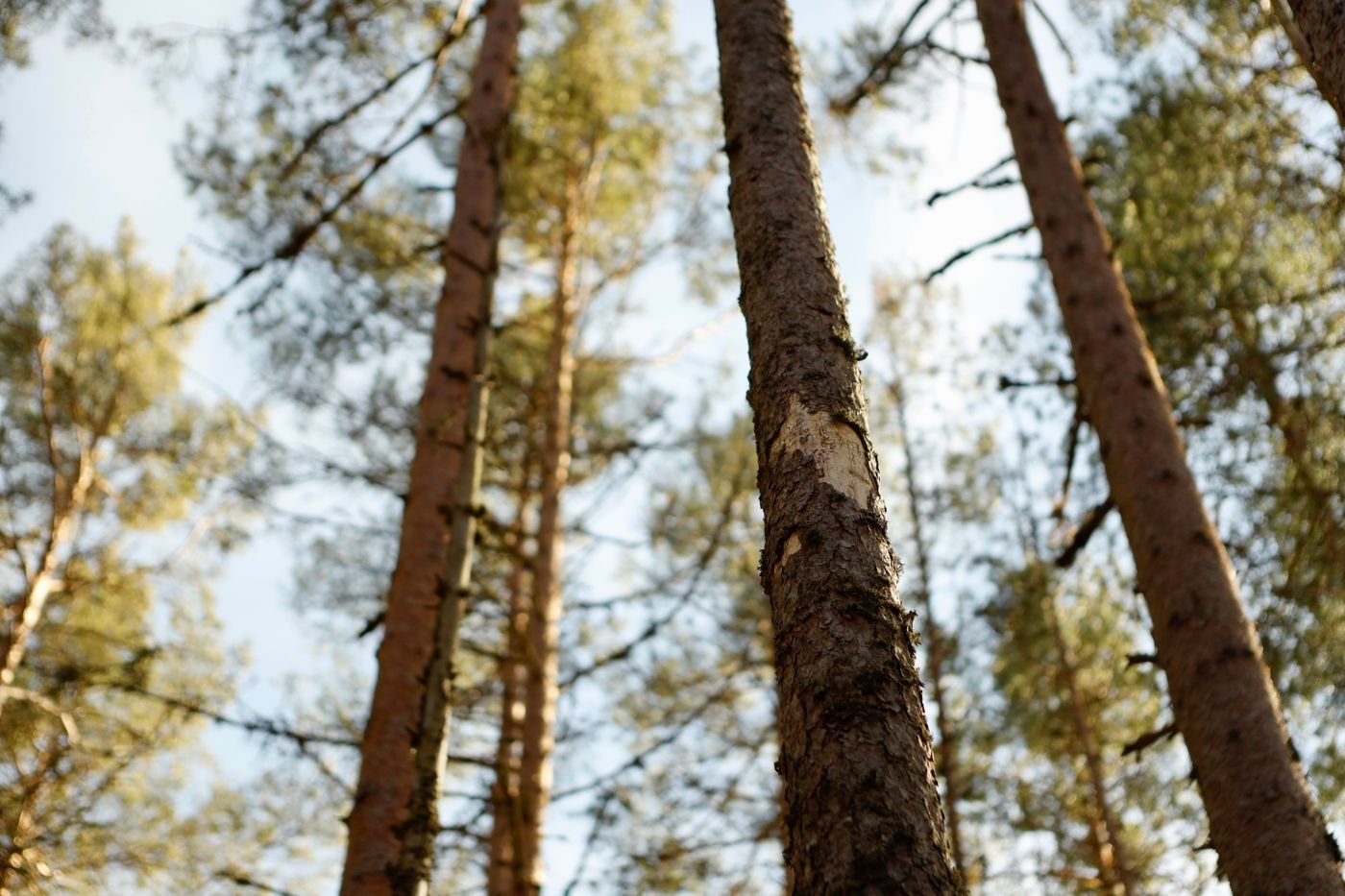
Yes, and more easily than most hardwoods. The reason comes down to one biological difference: pines do not resprout from old wood.
Cut a live oak back hard and it pushes new growth from dormant buds along the remaining branch. Cut a pine branch back past its green needles and nothing happens, ever. That stub stays bare for the life of the tree.
The two ways people kill them
Topping. A pine grows from a single central leader with a distinct growth point at the top. Remove that and the tree cannot simply elect a replacement the way a spreading hardwood does. What usually follows is a cluster of competing weak shoots, or the tree steadily declines and dies. Topping a pine is close to a death sentence and it is not reversible.
Cutting into bare wood. Take a branch back to the trunk and that is a clean removal the tree can seal. Take it back to a point with no green needles beyond, and you have made a stub that will never regrow and will die back into the trunk. Enough of those and you have opened multiple entry points for decay.
What is safe
Removing whole branches back to the trunk, cutting just outside the branch collar. That is the only pruning most pines ever need.
Take dead lower branches, which pines shed naturally as they grow anyway. Take anything genuinely in the way of a roof or a driveway. Take storm-broken limbs back to a clean cut. Beyond that, leave them alone: pines are self-shaping and they do not want help.
Take no more than about a quarter of the living canopy in a season, and less on a mature tree.
Pines in Austin are already out of place
Worth saying plainly: pines are not native here. Loblolly pine country starts well east of Austin, where the soil is acidic and sandy and the rainfall is considerably higher. Almost every pine in a Central Texas garden was planted, often by someone who missed them from somewhere else.
That means they arrive already stressed. Our alkaline limestone soils lock up iron, which is why so many Austin pines show yellowing needles: chlorosis, not disease. Blackland Prairie clay holds water around roots that want drainage. And the summers are simply longer and hotter than the species is built for.
A pine here has no margin for a bad prune. The same cuts that a loblolly in East Texas shrugs off can finish one in Austin.
When to cut
Late winter, while the tree is least active and before the spring flush. Avoid pruning in spring when sap is running heavily, and avoid deep summer when the tree is already managing heat stress.
Unlike oaks, pines do not need their wounds painted, and there is no oak-wilt-style closed season. The general rule against wound dressings applies here.
If it is already dying
Browning from the top down, needles dropping through the canopy rather than just the lowest branches, or pitch tubes on the trunk mean the tree is in trouble. Pines decline fast once they start, and a dead pine is brittle and unpleasant to take down, which makes it more expensive the longer it stands.
Yellowing needles with green veins is usually chlorosis from our alkaline soil, which is a different and more treatable problem. See signs a tree is dead or dangerous, and dead tree removal if it has gone past saving.
Got a pine that needs work? Send a photo of the whole tree and we will tell you what can safely come off. See tree trimming in Austin. We cover Austin, Pflugerville and eight more cities.